2.1.5/2.1.6 Neoclassical AD/AS Analysis
This includes information from sections:
- 1.5 Short Run Aggregate Supply (SRAS)
- 1.6 Long Run Aggregate Supply (LRAS)
Difference between Keynesian and Neoclassical Models
The key difference between the Keynesian and Neoclassical AD/AS models is:
- The Keynesian model assumes that markets will not clear, due to sticky wages. Implication: get the government involved to start up the Economy.
- The Neoclassical model assumes that markets will clear (eventually). Implication: leave the market alone, it will sort itself out.
Long Run Aggregate Supply (LRAS)
This model looks at the economy over two time periods, and therefore has two different types of Aggregate Supply curves:
- Long Run Aggregate Supply (LRAS)
- Short Run Aggregate Supply (SRAS)

Long Run Aggregate Supply (LRAS) shows the total output that the economy can produce. It represents the total possible output from our factors of production.
It is perfectly inelastic because production levels in the long run do not depend on price. They only depend on the quality and quantity of factors of production.
The LRAS while shift due to real changes in the economy. This means that we have made changes in the quality and quantity of factors of production. These are changes that are out in the real world and affect our ability to make things, rather than just changes that affect the price of things.
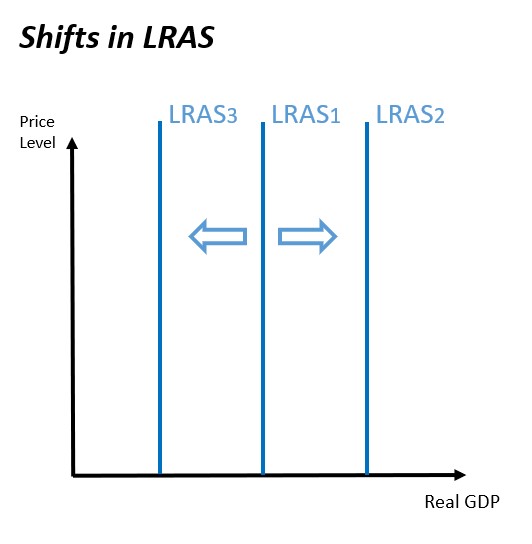
| LRAS Shifts Left | LRAS Shifts Right |
|---|---|
| Outward migration | Technological advances |
| Ageing population |
Improved education/skills |
|
Decreased factor mobility |
Inward migration |
|
Destruction of infrastructure |
Decreased regulation |
|
Increased regulations |
Improved completion policy |
|
Improvement of entrepreneurial environment (including lower income taxes) |
You will recall that this is all very similar to the sorts of changes that will affect a Production Possibility Frontier (PPF). In fact, LRAS and a PPF both describe the same thing.

A right shift in LRAS can be interpreted as shifting out the PPF.
A left shift in LRAS can be interpreting as shifting in the PPF.
There is also a link between LRAS and the business cycle. LRAS represents long run or potential growth. As LRAS keeps shifting to the right, the trend rate of growth keeps increasing:

This is because both LRAS and the trend rate of growth are affected only by real factors in the economy: the underlying conditions that determine the quality and quantity of factors of production.
Short Run Aggregate Supply (SRAS)
Short Run Aggregate Supply (SRAS) is the amount that an economy can produce at any given price level.
In the Short Run we assume
- nominal wage rates are fixed
- at least one factor of production (usually capital) is fixed.
In other words: we can make more, but only with the capital we’ve got currently. And our workers can’t negotiate a new wage level (yet).
The first assumption that nominal wages are fixed is a technical one. It means that for any given SRAS curve, we assume that we cannot change the money wages we pay to workers. When we change the wages of workers, we need a new SRAS curve (as we’ll see in the next section).
The second assumption is pretty standard assumption of the short-run, which is more well-used when looking at Theory of the Firm.

The SRAS curve slopes upwards because a higher price level in the economy incentives firms to increase their output. The higher prices will allow them to make greater profits.
SRAS shifts due to nominal changes in the economy, meaning changes to the costs in factors of production. This does not affect the quality or quantity of factors of production, but rather the price that is paid for them.
Any factor which will make your factors of production cheaper will shift SRAS to the right. For any given price level, firms will be able to produce more.
Any factor which will make your factors of production more expensive will shift SRAS to the left. For any given price level, firms will be able to produce less.

| SRAS Shifts Left | SRAS Shifts Right |
|---|---|
| Increased wage rates | Lower wage rates |
| Increased raw material prices | Decreased raw material prices |
| Increased taxation e.g. VAT | Decreased taxation e.g. VAT |
|
Weak currency |
Strong currency |
Being able to interpret real-world changes to AD, SRAS, and LRAS will give you the ability to analyse how the changes affect Price Level (inflation) and Real GDP (economic growth) using an AS/AD framework.